Tuesday 31 December 2013
Week Fifty-Three - Jeanette
Collected Poems 1909-1962 by
T.S. Eliot (1909-1962)
Recommended by Jude

People spend years
studying the poetry of T.S. Eliot. They don’t usually chuck it into their brain
at Victoria Coach Station.
I did not even have a week
in which to read this. The combination of adding an extra book to Two Readers and the cumulative effect of the occasional late post left me with eight books in December. But, 2013, throw
all the shit you want at me (as I just wrote, today it’s a malfunctioning laptop power pack, meaning I’m racing to
do this standing up in Hillsborough's Wetherspoons as the battery life ticks down and new year revellers start piling in) but, fuck you, I’m finishing Two Readers on time.
I want my world to end
with a bang, not a whimper.
Jude writes, in her
dedication at the front of my copy of Collected
Poems 1909-1962, that Eliot’s poetry ‘made me realise the real magic of the
English language.’ Perhaps, then, it’s not such a bad thing that circumstance
has forced me to pelt through it. I’m reacting in a very primal way, thinking
of the way the words dance on the page, feeling the direct relevance that the
poems brought to my world.
We
shall not cease from exploration.
(‘Little
Gidding’)
I saw Jude last night –
the wonderful Jude. We were with others, so we didn’t get too long to reflect
on the project, but I will tell her now that Two Readers has been one of the most satisfying creative
experiences of my life. Even though Jude’s posts weren’t regular, they were
brilliant and inspiring, and the credit for turning my idea for book recommendations from friends into a blog entirely
lies with her. That’s what true friendship does: one of you has an idea, the
other has an idea, you do something amazing together. Iron sharpens iron. I have felt her hands on my back, supporting me, in so many precious ways this year.
What
are the roots that clutch, what branches grow
Out
of this stony rubbish?
(‘The
Waste Land’)
‘The Waste Land’ came into
Jude’s life when she was in sixth form, which provides a curious parallel with
the book I recommended for her. We’ve often talked of what made us want to
write, and what made us writers (two different things). That era, age sixteen-to-eighteen, is perhaps the key
one of my life, and I know she feels similarly.
The
tiger springs in the new year.
Us
he devours.
(‘Gerontion’)
Jude and I have each had a
very difficult 2013, for different reasons. But through it we have been there
for one another. Writing about the people very very closest to me, of whom Jude
is one, is not easy. Because there is so much to say about someone I love so
very much. So perhaps less is more.
Both
intimate and unidentifiable.
(‘Little
Gidding’)
Just as there’s so much to
say about these bloody incredible poems. (And so little time to say it.)
The first of my favourites
is ‘The Hollow Men’. I knew I’d love it just from the Heart Of Darkness epigraph. And then this comes…
Between
the idea
And
the reality
Between
the motion
And
the act
Falls
the shadow
(‘The
Hollow Men’)
That’s exactly how I’ve
felt this year. I’ve felt shadows in my mind, on my heart, in my creative
process, coming between thought and result. How can one fight a shadow? I’ve tried. And I am hard on myself when I fail. But Eliot's words buoyed me, they swaddled me, they told me that I didn't need to hate my failure quite as much as I do.
Many of the poems have a
strong religious element. There’s clearly a schooled element to Eliot’s
Christian history, but there's also playfulness. Take ‘The Hippopotamus’. Its opening
lines relate to how huge the animal is, but that it is ‘merely flesh and blood’
compared to the True Church. The poem vacillates between a seemingly genuine devotional
fervour and a ludicrous piss-take, particularly with Eliot's glorious image of the
hippo ‘performing on a harp of gold’.
For Eliot does have quite
the sense of humour, and he sometimes tries to ‘help’ the reader with notes and
references, particularly in ‘The Waste Land’.
I do not know the origin of the ballad from which these
lines are taken: it was reported to me from Sydney, Australia.
(‘Notes
on The Waste Land’)
Cheers, Thomas Stearns.
But what of ‘The Waste
Land’ itself? It is astonishing.
Imagine everything in English literature from Sir Gawain And The Green Knight to Lily Allen. I am simply
overwhelmed. The word awesome is so overused, but with reference to 'The Waste Land', I mean it in its
original I-am-struck-with-awe sense. Written in 1922, my initial impression is that its some sweep
of post-Great War British culture, putting it in the context of the long Christian
epoch of the country: of how societies fracture and repair, how traditions
break and form. I also loved the references to Dante's Divine Comedy, my only other poetry foray this year. I haven't had the time to research anything of Eliot or his literary intentions, but I have learned from the book jacket that he was an American who settled in the UK
in 1915. Perhaps that completely scuppers my theory, but perhaps not: the eyes
of the new sometimes open wider, and cry fresher tears.

Since ‘The Waste Land’ is
so impossible to sum up, perhaps I should just leave it there before I
embarrass myself, and conclude with mentioning my other favourite poem, ‘East
Coker’, part of Four Quarters.
As
we grow older
The
world becomes stranger, the pattern more complicated.
(‘East
Coker’)
This long poem feels like
a very personal reflection, a song of experience, one which lights the bonds of humanity. Those ties that transcend the spoken and pull us on to the new. I expect that’s why it has hit me so very hard on this, the old year’s night. I have read fifty-three books and I have loved fifty-three people. I'll never do it again. But I'll never forget it.
In
my end is my beginning.
('East Coker')

Week Fifty Two - Jeanette
Housekeeping by Marilynne
Robinson (1980)
Recommended by Stuart

Having
a sister or a friend is like sitting at night in a lighted house.
I spent Christmas in
Oxford, with Kathryn and her family. We played Yahtzee, we drank Lidl’s knock-off (and far nicer) version of
Southern Comfort, we watched The
Manchurian Candidate. Spending the festive season there was indeed like
sitting at night in a lighted house. Lighted with the mini-bulbs on the tree, and a family’s love.
It’s still Christmas (ish).
If I can’t be sentimental now, then when?
I also read Housekeeping. I purposefully kept this
as the penultimate Two Readers book because
I suspected it would be one of my very very favourites. And so it proved.
Anyone that leans to look into a pool is the woman in
the pool, anyone who looks into our eyes is the image in our eyes, and these
things are true without argument, and so our thoughts reflect what passes
before them.
Thank you, Stuart Evers. Here
he is cooking an egg. (He hates eggs).
Why is he cooking an egg
on Battle Of The Pans for charity? Because he’s only an acclaimed novelist with two fabulous books to
the good, Ten Stories About Smoking and
If This Is Home.
I’ve known Stuart for ages
now, way before either of us had a published book. (Always satisfying to say
you knew them before they were famous, darling). We met during the
post-university social whirl. He was friends with my friends, and a proper looker. I couldn’t fail to notice
someone with his kind of louche grace! The first time I spoke to him properly I
was about 22, and we were at (the now sadly closed) Rowan’s Bowling Alley in
Finsbury Park. Neither of us could bowl but both of us could drink. The former
was quickly abandoned for the latter, and we’ve been friends ever since.
He recommended both Jude
and I fifty-two books to read. What a guy. Jude chose Georges Perec's Things; I decided to
leave my book to the hand of fate. In our modern world, that hand equates to a
random number generator on the internet. Although I promised the generator I
would read Jack by AM Homes, I immediately broke that promise, because I saw Housekeeping at four. I knew that was the one.
(By the way, I’m keeping
Stuart’s list of other novels for future reference. This year has taught me
that I need to be far less sniffy about contemporary fiction. Stuart writes an
excellent blog, and here is his list of this year’s best books. I shall be
delving into that, too.)
Why did mine eye alight on Housekeeping? Partly because I knew it
to be an important modern novel, but mainly because I was fascinated by
Marilynne Robinson’s approach to fiction. Housekeeping,
her first novel, was massively lauded at publication in 1980 and nominated for
the Pulitzer Prize. Gilead, her
second novel, was massively lauded at publication in 2004 and won the Pulitzer
Prize. Twenty-four years and two masterpieces at either end. I have the hugest
amount of respect for people with very high inner critics who will not dish up
anything unless they are sure it’s astonishing.
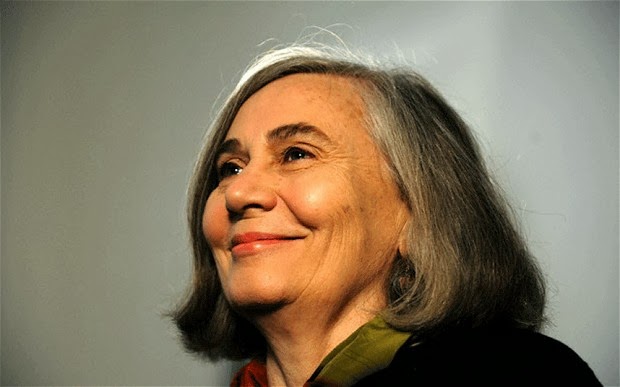
Housekeeping’s power is stealthy. You
get to know characters as you would in real life: they don’t dump out the
contents of their individual personal history handbag on the table the first
time of meeting. They’re guarded, waiting until they can trust you, sure that
you understand them. And, because you’ve worked to get to know them,
their tragedies become yours.
Ruth and Lucille, sisters
and orphans, are well acquainted with loss. Their mother, Helen, committed
suicide; their grandfather perished in a locomotive accident; their
grandmother, after caring for them for five years, ‘one winter morning eschewed
awakening’. They are then passed on to Lily and Nona, another pair of sisters.
Uncomfortable with children, they struggle to relate to the introverted Ruth
and Lucille.
‘That Lottie Donahue could help. Her children are alright.’
‘I met the son once.’
‘Yes, so you said.’
‘He had an odd look. Always blinking. His nails were
chewed down past the quick.’
‘Oh, I remember. He was awaiting trial for something.’
‘I don’t remember just what.’
‘His mother never said.’
Someone filled the teapot.
Lily and Nona aren’t bad
people, they just don’t really want the responsibility of bringing up two
troubled little girls while in their twilight years. They connive to palm them
off to Sylvie, Helen’s sister. Sylvie is a transient, who sleeps with her shoes
under her pillow: an enigmatic woman who few people understand (or wish to). However,
living with Ruth and Lucille brings her a sense of home, and the girls, at
least initially, find solace with her unusual ways.
Not an especial amount
happens in Housekeeping until the
final fifty or so pages, when separation trauma becomes the primary theme. First
comes a deeply upsetting schism between Ruth and Lucille, the latter growing
embarrassed by Sylvie’s unusual behaviour – so much that she is prepared to
forego her sister and Sylvie's defender. Very realistically, Robinson pulls out the hardness and the
pity of how two formerly inseparable people grow apart.
‘It wasn’t the flowers, Ruthie.’
That sounded rehearsed. I waited, knowing that she would go on.
‘It was much more than that. We’ve spent too much time
together. We need other friends.’
It isn’t only Lucille who
views Sylvie as an unsuitable mother figure. The reader has been used to seeing
Sylvie’s housekeeping from Ruthie’s perspective; all of a sudden we see it from
a conventional viewpoint. The final act of Housekeeping
is a quietly harrowing exploration of how alternative relationships and
living situations are seen from the outside. Just as with Robinson’s
characterisation of Lily and Nona, there’s no judgement against the people who
are not comfortable with Sylvie and Ruth’s lifestyle. Although I felt Ruthie
clinging on to Sylvie very strongly, also (and perhaps because I’ve worked in
social care research) I understood also how they could not be left as they are.
Neighbours don’t only stick their noses in because they don’t approve. There is
a genuine, and laudable, desire to protect children from harm. Neglect is the
hardest form of abuse to detect and to stop, and the consequences of not
listening to that voice that says ‘that family down the street are worrying me’
could result in another Victoria Climbie or Baby P.
The book seems to be
called Housekeeping because it looks
at how we keep our homes in order: the domestic chores and the emotional
well-being. Two Readers has been a
sort of housekeeping, too. Reading and blogging on a book a week offers up its
routine, while the critical reflection and heartbursts of love for my friends
has been its emotional ballast.
Housekeeping this blog,
and getting them all in before the end of the year, was something I thought I
could do. I really did. But today my laptop power pack has broken: I've written my final post, Jude's recommendation of course, and I'm hoping the remainder of the battery will hold while I put it up.
2013, you bloody drama queen to the end.
Saturday 28 December 2013
Week Fifty-One - Jeanette
Written On The Body by Jeanette
Winterson (1992)
Recommended by Anita

My body is written on.
I have three tattoos. Each
is a carefully chosen design, patterns I knew I wanted indelibly inked upon me.
The nuances shift, but their core meaning doesn’t: they represent transitions.
I got each one during the final element of a pupa stage. They are memento moris of my past lives.
(We tattooed people do
witter on about how deep ‘n’ meaningful the things are. Boring bores, the lot
of us.)
But, lately, I’ve been
wondering if there’s another, less highfalutin' reason for my tattoos. I think
it’s also an expression of my background, a branch from the same root as liking
amusement arcades and gaud at Christmas. Loads of people I grew up with have
them. If you don’t tattoo the name of your child on your arm, well, what kind
of mother are you? Don’t you love your kid?
I feel kinship with
Jeanette Winterson. She has my name! There are precious few of us Little Jeans
around. But, too, she was a working-class girl who found herself running with a
different crowd when she went to university. For me, the process had already
started before I left Norwich (a schoolfriend accused me of being a class
traitor), but it certainly solidified after the age of eighteen. I never
thought of it as a conscious denial of my background, although I’m sure others
saw it that way. As I wrote in Week Sixteen, there are only two people from my
pre-uni days involved in Two Readers.
It's a minor part of the book, but Winterson’s Oranges Are Not The Only Fruit captures
this chequered experience well: the excitement and feeling of belonging with your
new life, coupled with the sense of loss for the old.
In her autobiography, Why Be Happy When You Could Be Normal?, Winterson revisits the material she drew on for Oranges. Her conflicted feelings about her upbringing (and apart from the class aspect, her family circumstances are very different to mine) continue to be source material for her. Having read those two works, I approached Written On The Body with veiled autobiography in mind.
It was an interesting book to tackle directly after The Pursuit Of Love.
I had said them many times before, dropping them like
coins into a wishing well, hoping they would make me come true. I had said them
many times before but not to you. I had given them as forget-me-nots to girls
who should have known better. I had used them as bullets and barter. I don’t
like to think of myself as an insincere person but if I say I love you and I
don’t mean it then what else am I?
The gender of Written On The Body’s narrator is never
revealed, yet (perhaps because of my association of Winterson with memoir) I
found myself thinking of that narrator as ‘her’ throughout. I assumed one of the
country’s top lesbians must be mining her own relationships with women.
But of course it could be a man, or a transgendered person. (There is no Smack My Bitch Up ‘surprise’ twist
ending). I also suspect Winterson was drawing attention to the difficulty of
expression without gender pronouns, critiquing how binary and constricting
those categories are.
We begin by reading of the narrator’s back love catalogue. The
prose is graceful, charged and often erotic, although it does sometimes spill
into floridness.
I watched her break and butter each piece, soak it
slowly in her bowl, let it float, grow heavy and fat, sink under the deep red
weight and then be resurrected to the glorious pleasure of her teeth.
I do like it when
Winterson gets a bit bawdier, too.
June. The wettest June on record. We made love every day.
Most of the narrator’s women
are flowing-locked anarcho goddesses (‘I had a girlfriend once who was addicted
to starlit nights.’ Not addicted to Tetris,
then?), but perhaps this is intended to show how the narrator
idealises love objects rather than as a parade of unrealistic females. The
Helenest of these Helens Of Troy is Louise: the pair embark upon an erotic and
emotional odyssey until we discover that Louise’s body is more than
honey-filled breasts and love-saturated heart. It has been invaded by leukaemia.
We are beholden to our
bodies and, suicide aside, it is the body that has the ultimate control: the
power of life and death. (That’s another reason why I decided to get tattooed.
The body does enough stuff that you don’t want it to do, might as well get it
to do something you do). The narrator now has to come to terms with this, and
the book’s interlude, the extended prose poem ‘The Cells, Tissues, Systems And
Cavities Of The Body’, explores Louise’s physicality as something more than
sexual. It is an expression of the narrator’s love, framed by the new awareness of
the cancer spraying graffiti on the inside and outside of Louise’s body.
Will you let me crawl inside you, stand guard over you,
trap them as they come at you? Why can’t I dam their blind tide that filthies
your blood? Why are there no lock gates on your portal vein?
Like Dennis Quaid in Innerspace, the narrator roams around:
you can hear fingertips running on the corrugated roof of Louise’s mouth.
But, when the narrator returns to the corporeal world, the hard fact of Louise’s
illness is still there. What is more important, the health of the body or that
of the heart?
One of us hadn’t finished, why did the other one go? And why without
warning?
This novel didn’t, for me,
have the personal clout of Oranges Are
Not The Only Fruit: the story seems deliberately not as strong, almost as if Winterson
thinks that an abstract narrative is a more valid approach to
literature. But I really enjoyed getting lost within Louise’s capilliaries, climbing
her spine stepladder, being swaddled by her intestines.
And while we’re thinking
of bodies, what body do you picture when you hear ‘mermaid’? Ariel in The Little Mermaid? Daryl Hannah in Splash? Cher in fancy dress? Jerry Hall
on the cover of Siren? Chances are it
isn’t this…

Cryptozoology is a word I
had never encountered before I met Anita. It refers to the study of fake or
unproven creatures like the Loch Ness Monster, the Yeti, and Norfolk’s own
Black Shuck. (Look at this fascinating list of cryptids – a Man-Eating Tree!).
And then there’s The Buxton Mermaid, that beauty above.
Anita restored her. She is
also her ambassador, telling her story to the press and to museums. Her care of
The Buxton Mermaid goes beyond a job, and that is typical Anita. She
will give her time and her support to those (and crypto-those) who she loves. She’s
certainly done it for me. When I was in the midst of a crisis, Anita not only
propped me up with words and hugs, she came to my place and did my washing-up.
When everything is surreal because sadness is so huge, to have someone who can
gently re-orientate your world, so you’re in no doubt it’s still worth living
in because you have friends like her… it is a key to recovery.
I love conversing with Anita about books. (She's Tim's sister, equally as erudite as he) and as the year, and this
project, has written itself on my body, I've realised I have my Two Readers friends to thank for
more than just their book recommendation. It’s talking about the posts, sharing
thoughts on the books in person, and to hear other interpretations of the stories and ideas that has been so incredibly inspiring, and the motivating factor in getting me to book fifty-one out of
fifty-three.
Hold on to your hats. There
are two amazing works coming down the
Two Readers bridleway before midnight
on the 31st of December, 2013.
Tuesday 24 December 2013
Week Fifty - Jeanette
The Pursuit Of Love by Nancy
Mitford (1945)
Recommended by Katherine

When I moved into my
present flat (helped by Katherine, as well as Sharron, Nik, Tim, Kathryn,
Rupert and the still-to-come Anita) I didn’t have much furniture. What I need, I said to Katherine, is not really a bed or a table. It’s a lovely
vintage writing bureau.
‘I’ve got one of those in
my garage,’ she said. ‘You can have it if you want.’

Since that beauty took up
residence in the corner of my lounge, I cannot imagine life without it. Not
having separate sections for creamy high gsm envelopes and the pound-shop
jobbies for sending off the council tax? Pure savagery. (That sounds sarcastic
if you don’t know me, but if you do, you’ll know how absolutely in earnest I am.)
But, more importantly than even the correct ordering of stationery, I cannot
imagine life without Katherine as my friend.
Last time I saw her, for a
Christmas drink, our natter flitted between the effect of topography upon
memory and the pantos we have known and ‘loved’; literary stylings and how Jem and the Holograms dolls were overpriced compared to
Sindys. (Plus her husband comes from Norfolk. She’s as wry about the place as I
am.)
Katherine is only a bloody
qualified librarian, too! That’s the Red Rum (winning horse not backwards
prophecy) of literary suggestion, right there. That’s why I wasn’t worried when
I picked up The Pursuit Of Love and
it had a hot-pink, Sophie Kinsella reader-friendly cover and praise from the
Daily Mail on the back. I also wasn’t worried because I knew that Nancy Mitford
was big mates with one of my revelations of the year: the prickly prince EvelynWaugh. And I certainly wasn’t worried when I started reading her cut-glass
prose.
Over the chimney-piece plainly visible in the photograph
hangs an entrenching tool, with which, in 1915, Uncle Matthew had whacked to
death eight Germans one by one as they crawled out of a dug-out. It is still
covered with blood and hairs, an object of fascination to us children.
The children include our
narrator, Fanny, and her cousin (the book’s protagonist) Linda. A dramatic
youngster, Linda attempted suicide by yew-berry at the age of ten (because of a dead dog). They both
love Oscar Wilde and long for adulthood, because they presume it will be all
social whirls and Grand Love.
While Fanny quickly gives up on the latter and settles for the up-down-four-square Alfred, Linda keeps her idealism and it,
naturally, leads her to missteps. Seventy years ago,
people generally married these missteps. First up for Linda is the Conservative
MP, Tony Kroesig, son of the Governor of the Bank of England. I found the
characterisation of the Kroesig family brilliant but extremely depressing,
because it is exactly analogous to the Tory attitude of today.
The only mental qualities that they respected were those
which produced money in substantial qualities, it was their one criterion of
success, it was power and it was glory. To say that a man was poor was to label
him as a rotter, bad at his job, idle, feckless, immoral.
It doesn’t work out with
Tony.
Next, Linda throws herself
into marriage with a Communist, Christian. His bad points are of a different
hue.
‘I’m always saying to Christian how much I wish his buddies would
either brighten up their parties a bit or else stop giving them, because I
don’t see the point of sad parties, do you? And left-wing people are always sad
because they mind dreadfully about their causes, and the causes are always
going so badly.’
It doesn’t work out with
Christian.
Linda’s refusal to settle leads
to Paris and to a man named Fabrice (‘she was filled with a strange, wild,
unfamiliar happiness, and knew that this was love’); but, for some of her
social circle, her swelling heart doesn’t matter. She should have stuck with Tony or, at a
push, Christian. She’s judged as superficial, reckless and selfish, quick to bugger off at the first sign of trouble to look for
a pipe dream. Yet, the reader is led to a far kinder
conclusion. Linda is pursuing love, and second best is never enough: you’ll do
much better, baby, on your own.
Since we’re quoting
Madonna, I re-watched Who’s That Girl lately,
and it popped into my head while reading The
Pursuit Of Love.
Now, I’m making no claims
for its cinematic qualities (it’s quite crap). I bring it up as a point of
comparison that’s easy to forget when you largely live in a literary fiction
and arty movie bubble. At the end of Who's That Girl, Griffin Dunne jilts his dullard fiancée for
the unconventional Madge, which is a textbook example of a standard and
extremely common dramatic device. From the breezy chimes of Busted’s ‘Crashed
The Wedding’ to the more textured The
Graduate, those who pursue love (especially by taking drastic action) are treated
in one way and one way only. They are rewarded. In real life, they’re generally
not. For a start, we usually take the
hint that we’re not wanted when our darling gets married to someone else. In popular
fiction, the heroes and heroines are so thick-skinned that they see the
nuptials simply as another hurdle to leap, and no-one will be upset, or angry
that the thousands spunked on a wedding is wasted.
What I really liked about The Pursuit Of Love was that, even while
it uses some of the expected structure of romantic comedy, there’s a strong discomfort
about happy-ever-after. For when Linda does find love with Fabrice, she is put off by his apparent commitment to
someone else (a dead woman: how can anyone compete with that?). It is not at
all clear that when Linda finally has her strange, wild, unfamiliar happiness
that it will result in anything like a conventional relationship, or even a
relationship at all. In this way, it is very similar to the other major work
I’ve read on l’amour this year, Gabriel
Garcia Marquez’s Love In The Time Of Cholera. Unlike ...Cholera, though, The Pursuit Of
Love’s épée to cut through love’s cliché is not philosophical intensity
but sharp wit and brutal social observation. It has a light comedic touch and
firm location in a contemporary setting.
I think I said all I
wanted to say about love in relation to the Marquez work. When I wrote that –
my favourite post of the year – I was in the eye of a perfect storm, and that
book was my lightning rod. Now it’s Christmas Eve, I have three books left of Two Readers, and a real storm is raging
outside, pulling trees from their roots and causing brick walls to tumble down.
‘He
was the great love of her life, you know.’
‘Oh, dulling,’ said my mother, sadly. ‘One always thinks that. Every,
every time.’
Thursday 19 December 2013
Week Forty-Nine - Jeanette
The Autobiography Of Malcolm X
by Malcolm X (as told to Alex Haley) (1965)
Recommended by Sarah

A little over a year ago,
Sarah and I were in Egypt.
We weren’t just arsing about in the pyramids (although we did that, too): we were working as
part of the TEMPUS project at the universities in Cairo and Assiut. We were there at a turbulent time. President Mohamed Morsi had granted himself unlimited power, and there were sweeping protests against this. If you remember the story, you probably recall UK news emphasising violence and disorder.
That contradicts what I
saw. Sarah and I went to Tahir Square with our Egyptian host. Yes, there were some
disturbing embers of conflict – rubble, tanks, streets closed off – but the
protests we saw were non-threatening. They had a message to be heard, the
people were determined, but the method was intelligent serious debate and not aggression. Protesters even
organised the street clean-ups. This politically engaged attitude was also present in
the students Sarah and I met at the universities. Apathy wasn’t on the table. Incredibly inspiring, and
something Sarah and I talked of over the crazy sludge that is Egyptian coffee
(which I got rather addicted to).
As the first time Sarah
and I had spent much time together, I found that she herself was pretty
inspiring. She is involved directly in the campaign for women bishops. I recently went
to an event that she organised, and was saddened and shocked at the depth of
opposition within the Church of England hierarchy to women bishops, while also
being supremely impressed with the fire of those working for progressive change.
With her willingness to stand up and be counted, it makes sense to me that
Sarah studied, and retains a very strong interest in, African-American history
and those who fought for political and human rights.

Malcolm X is a divisive
figure. While everyone (everyone non-racist) can feel comfortable with Martin
Luther King, Malcolm X is often accused of ‘reverse racism’. That, in his anger
at the oppression of African-Americans, he espoused an uncompromising solution:
complete segregation of black and white. He had a penchant for calling white
people ‘devils’ and was especially suspicious of any who supported civil rights
and integration.
I very much respect
Malcolm X. From my relatively privileged position, I still get so
worked up over inequalities that I want to throw paint at things; fuck, if I
was a black person in post-war America I’m sure I’d be angry, feel that white people were devils, and distrust their efforts to ‘help’.
My mother, with the baby in her arms, just made it into
the yard before the house crashed in, showering sparks. I remember we were
outside in the night in our underwear, crying and yelling our heads off. The
white police and firemen came and stood around watching as the house burned
down to the ground.
The Black Legion, a local
version of the Ku Klux Klan, set that fire. A white man raped Malcolm’s
grandmother (resulting in her pregnancy with Malcolm’s mother). White men
murdered Malcolm’s father, the Reverend Earl Little, because of his vocal
support for Marcus Garvey. As a child, the Little children were called
‘nigger’, ‘darkie’ and ‘Rastus’ so much ‘we thought those were our natural
names’. Malcolm, academically top of his class, was told to give up any
thoughts of being a lawyer and to be a carpenter instead.
Yes. I’d be really fucking
angry, too.
Malcolm Little (the X came
slightly later: it symbolises the true African family name that an
African-American could never know) responded, at first, through hustling,
drugs, pimping, crime and, as he terms it, being ‘mentally dead’. He is hard on
himself for collaborating with racist America by exploiting other black people
(selling drugs) and trying to ‘whiten’ his look by straightening his Afro hair. He ends up in prison,
and begins to read,
everything from rare anthropology texts to the dictionary itself. His curiosity
is piqued as to how and why slavery and exploitation occur.
First, always ‘religiously’, he [the white man] branded
‘heathen’ and ‘pagan’ labels upon ancient non-white cultures and civilizations.
The stage thus set, he then turned upon his non-white victims his weapons of
war. […] Europe’s chancelleries for the next century [19th] played a
chess game of naked exploitation and power from Cape Horn to Cairo.
It is during this period
when he becomes taken with the Nation Of Islam (NOI), led by Elijah Muhammad. NOI
teachings draw from mainstream Islam – there is no God but Allah, total adherence
to the Qur’an, prohibitions on alcohol and pork, for example – but have a
specific American cultural context. For instance, the ninth platform of NOI
reads:
WE BELIEVE that the offer of integration is hypocritical
and is made by those who are trying to deceive the Black peoples into believing
that their 400-year-old open enemies of freedom, justice, and equality are, all
of a sudden, their friends.
Also not a part of
mainstream Islam, and far more dubiously, NOI holds its own creation myth.
White people were the result of genetic engineering. Over six thousand years
ago, when all humankind was black, the scientist Mr Yacub (the biblical Jacob),
was embittered towards Allah. He holed up on the island of Patmos and created a
‘bleached-out white race of devils’ (the Jews). This white race stirred up
trouble, until they were exiled to Europe; they remained in caves, living
savagely, until Allah sent Moses to ‘civilise’ them.
This I find very troubling. I don’t have a problem
with African-Americans calling white people ‘devils’ on account of their
collective racist behaviour. I do have a problem with a bogus scientific explanation for devilishness that specifically targets Jewish people. We all know where that can lead.
As well as this ‘Dr Yacub’
business, the other big gripe I have with Malcolm X is his frankly atrocious
attitude to women. He casually and routinely comments on a woman's attractiveness, and how women in general are manipulative, have little purpose but to support a man and family, and should basically be treated as babies or pets. It's worth noting that this attitude predates his NOI days (although the organisation didn't exactly stop his misogyny).
Malcolm X rose through the
NOI ranks very quickly, and helped membership and visibility. His rousing and inflammatory speeches brought the race debates in America to a new intensity; he explained and challenged racism on TV and in print, often in the face of stupid and insulting interviewers.
Soon, far more
people knew his name than that of Elijah Muhammad. Malcolm X writes that he
remained loyal to Muhammad, even when scandal broke over the latter’s fondness
for impregnating his secretaries. He even massaged his
speeches in light of Muhammad’s indiscretions.
I began teaching in New York’s Mosque Seven that a man’s
accomplishments in life outweighed his personal, human weaknesses. I taught
that a person’s good deeds outweigh his bad deeds. I never mentioned the
previously familiar subjects of adultery and fornication, and I never mentioned
immoral evils.
However, like the
character Syme in Nineteen Eighty-Four,
who is eliminated because he ‘sees too clearly and speaks too plainly’, the
eloquent and high-profile Malcolm X is expelled from the NOI. Relationships deteriorate
quickly. Malcolm X tries to regroup – he undertakes a pilgrimage to Mecca,
spends much time in Africa, and converts to Sunni Islam – but, by the end of
the Autobiography, the mood is very
sombre indeed.
I do not expect to live long enough to read this book in
its finished form.
He didn’t. Nation of Islam
members murdered Malcolm X in February 1965.
I felt very galvanised reading The Autobiography Of Malcolm X, just as I was when I saw those Egyptian protests. For we need people who are not going to sit down and shut up.
It’s how shit gets done in
this troubled world.

Subscribe to:
Posts (Atom)